Aperture
Shipped
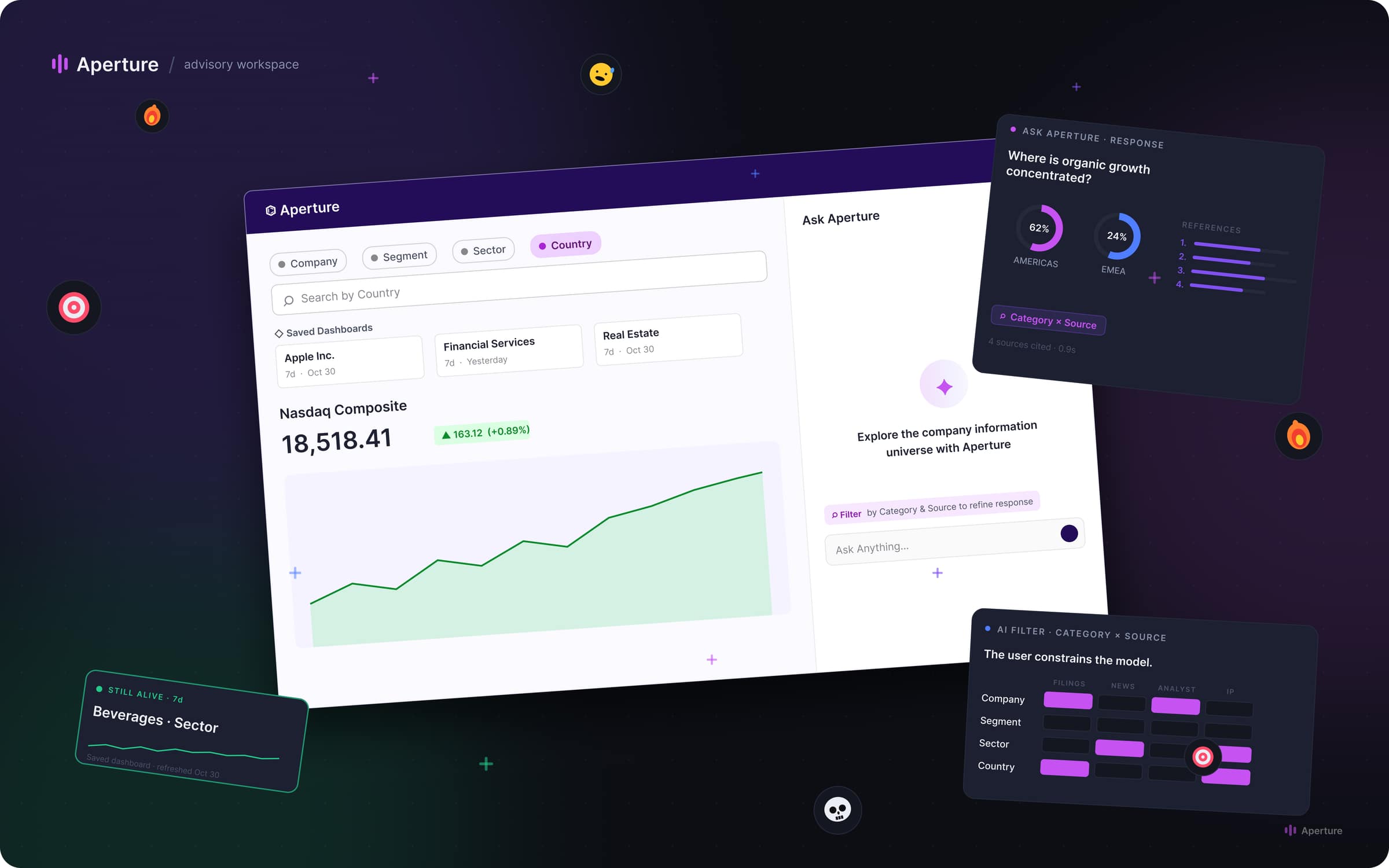
The AI workspace inside an advisory product, threads, structured responses, a faceted filter. The slice I owned on a 3-designer team.
Client
An AI pricing advisory founded by a former McKinsey strategy partner · designed at Coditas
Brief from
Advisory founders, via direct briefing
Team
3 designers, Lead (narrative), teammate (dashboard), me (AI surface)
Users
Founders for sanity checks; no end-advisor testing in scope
Role
AI Workflow Designer · 3-designer team
Platform
Web · B2B SaaS · AI Research Workspace
Duration
2024 → 2025 · 2 weeks · founding-team sprint
In short
- One slice of a three-designer sprint. I owned the AI workspace: threads, structured answers, and a faceted filter that lives inside the conversation.
- Two weeks at founding-team pace. The lead held client narrative, a teammate owned the dashboards, I owned the AI surface.
- Shipped. No end-advisor testing was in scope, so there are no usability numbers here, only what was built and handed over.
What it moved
The numbers, in plain sight.
2 weeks
Sprint length
3
Designers on team
6+
AI surfaces I owned
3
Patterns defined
The story · 4 chapters
How Aperture got built.
rev 00brief
What I owned.
❝An early-stage strategy advisory team wanted a workspace that does what a senior advisor does. Pricing, growth, due diligence.
The founders had a clear product direction. The design team's job was to turn it into a working, clickable product in two weeks.
We were three. The lead held client direction and product narrative. A teammate owned the dashboard: Company, Segment, Sector and Country filtering, charts, news, saved dashboards.
I owned the AI workflow, Ask Aperture. How it behaves, what an answer looks like, how the user constrains it.
This case study covers my slice.
Pull-out · Brief
1 slice
The AI surface, inside a 3-designer build
rev 01decision
The thread.
❝Every AI product I touched in 2024 failed the same way. The model talks too much, you cannot tell where the answer ends, and the conversation vanishes when the tab closes.
The lead's brief to me was direct. Do not ship a chatbot.
So I made the thread the unit.
Threads get named, like Beverages Market Size or EV Sales Outlook. They can be renamed, deleted, and they survive the session.
Each thread inherits whichever lens the user was in when they opened it, so prompts run pre-constrained.
An expand and collapse pattern lets the AI shrink to a side rail when the chart is the conversation, and fill the canvas when the AI is.
It is a small system, but the bet is structural. An advisor coming back on day 4 should find their thread alive and re-runnable.
Pull-out · Decision
Thread = unit
Named, durable, lens-aware
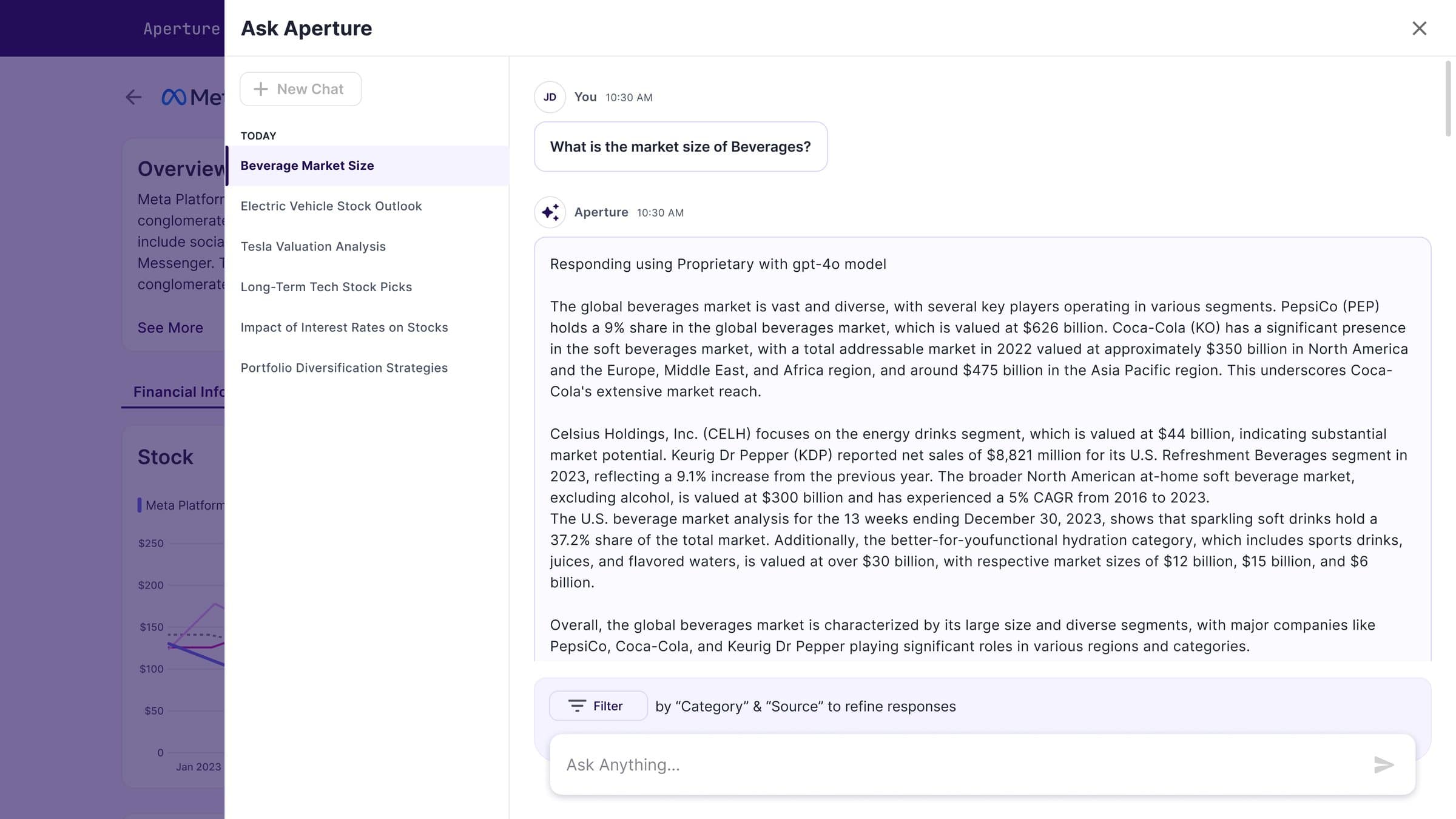
Ask Aperture, expanded, thread list on the left, main conversation on the right. The lens the user is in flows into the prompt.
rev 02decision
Constraining the model.
❝The hardest interaction was not the AI response. It was the AI filter.
Aperture can reach filings, news, analyst reports and internal IP.
If the model is free to pull from all of it on every prompt, the answer drifts and the advisor stops trusting it.
So the filter runs inside the conversation. The user picks a Category, then a Source. The model is held to the intersection.
The same question with different filters returns different answers, and the user sees exactly which subset the model read.
The response is not a chat bubble. It is a document. Summary, comparison chart, detailed table, numbered references.
Every claim clicks through to a source. An advisor who cannot audit an answer will not trust it.
Pull-out · Decision
Category × Source
Faceted picker inside the conversation
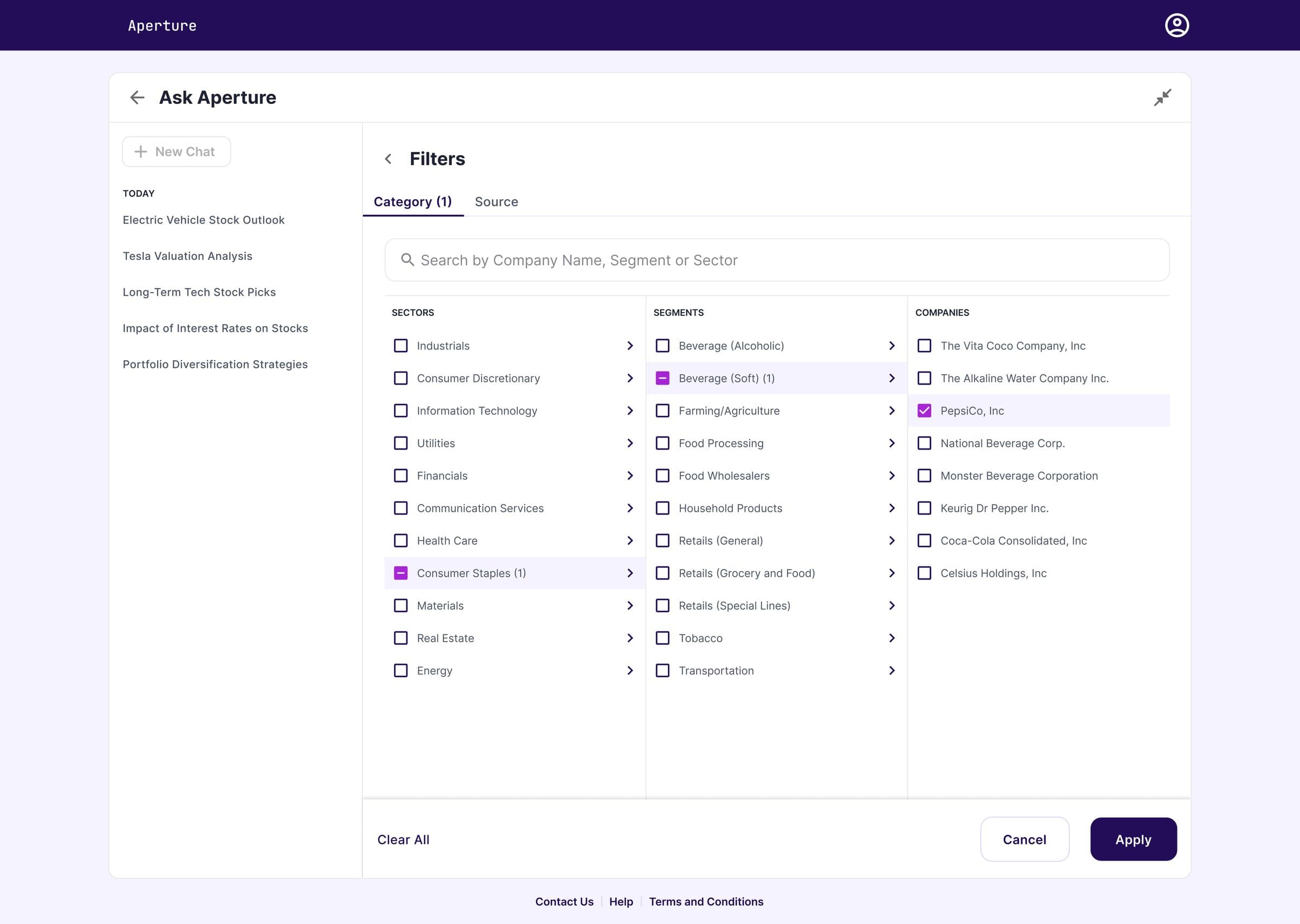
The AI filter, Category × Source. The user constrains the model; the model doesn't constrain the user.
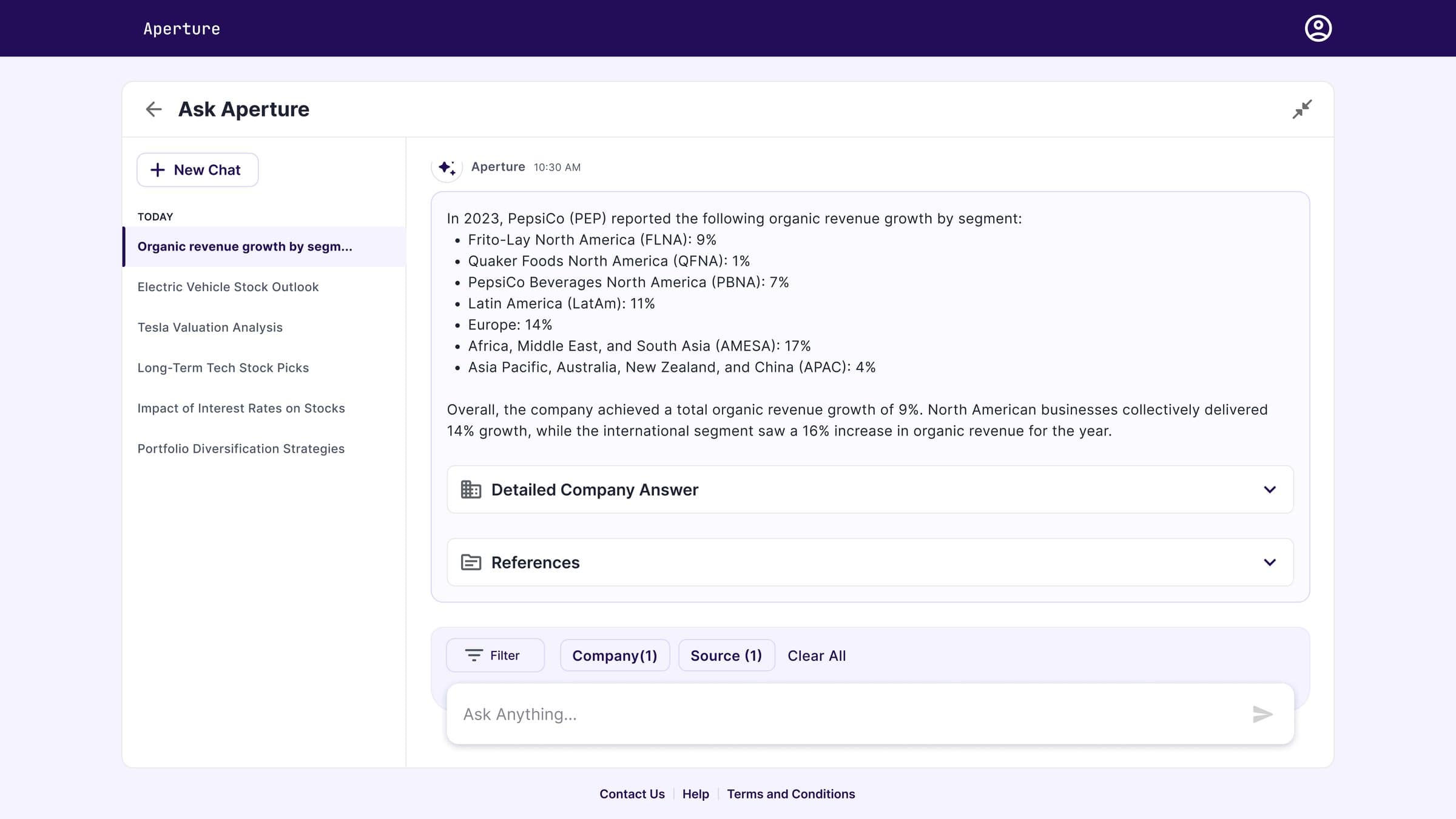
Filter-driven response, narrower subset, narrower answer, smaller reference list. The advisor sees what the model is and isn't reading.
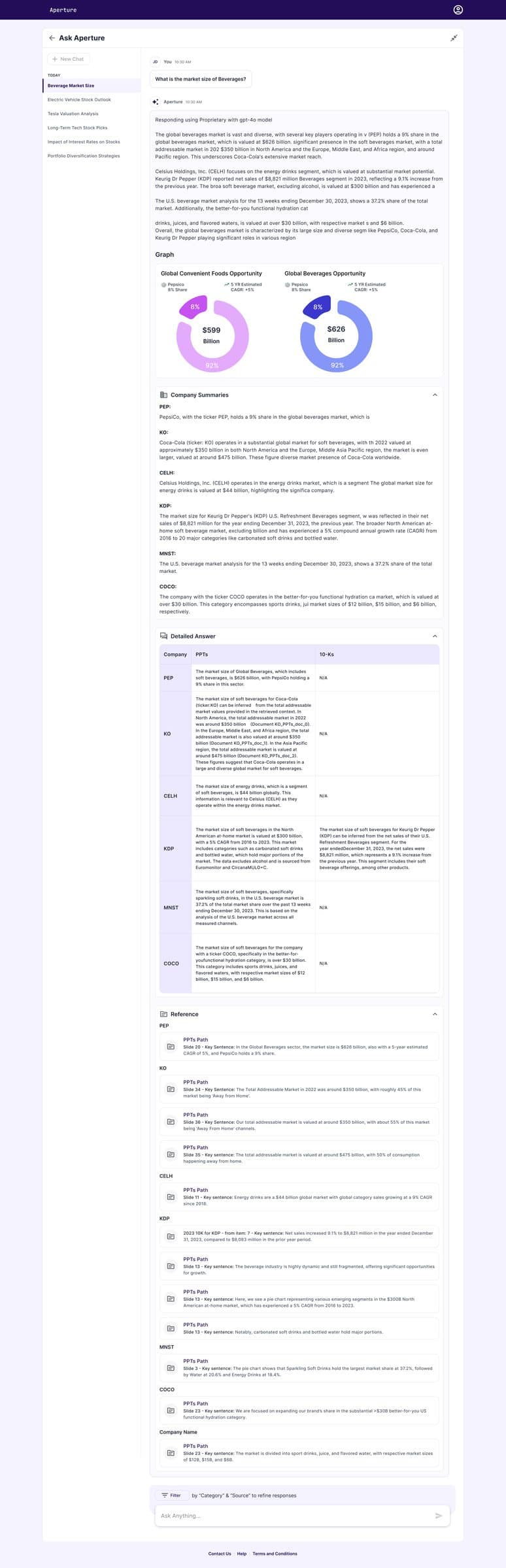
Full structured response, summary, two donut comparisons, detailed table, numbered references. The AI returns a document.
rev 03reflection
What two weeks earned.
❝Two weeks is enough to ship patterns. It is not enough to test them.
Three of them survived the sprint and made it into investor demos. Threads as the unit. Documents instead of chat. The filter inside the conversation.
The product the founders walked into pitch meetings with is the product we built.
The Founder and CEO carried these surfaces into the company's first full year of enterprise client work, later credited publicly with $M-scale outcomes. The team has since brought engineering in-house.
What I would do with more time: usability test the filter with real advisors. We sanity-checked it with the founders, and no end user ever saw it.
Tighten the empty-state copy. Add thread versioning, so one conversation can fork into what if the source was filings only, without losing the original.
The pattern is there. The lifecycle is not.
07. Threads as the unit. Documents instead of chat. A faceted filter inside the conversation. The AI slice of an advisory product, shipped in 2 weeks.
Want this kind of work on your team?